Audit Lab
Audit Lab is a deterministic, known-ground-truth correctness fixture. It creates invalid positive results on purpose, runs the corresponding safe controls, and writes a byte-stable evidence set.
microalpha audit-demo
No network, provider, credential, licensed row, or hidden holdout is accessed.
The only inputs are schema microalpha.audit-lab.v1, seed 20260715, and
NumPy-generated arrays bound by input_sha256.
The fixture uses transparent NumPy oracle constructions so every injected
failure has known ground truth. The production Engine and ExecutionPlan
path is guarded by
test_tplus1_execution.py,
while the shared max-statistic implementation is guarded by
test_multiple_testing.py.
Four paired audits
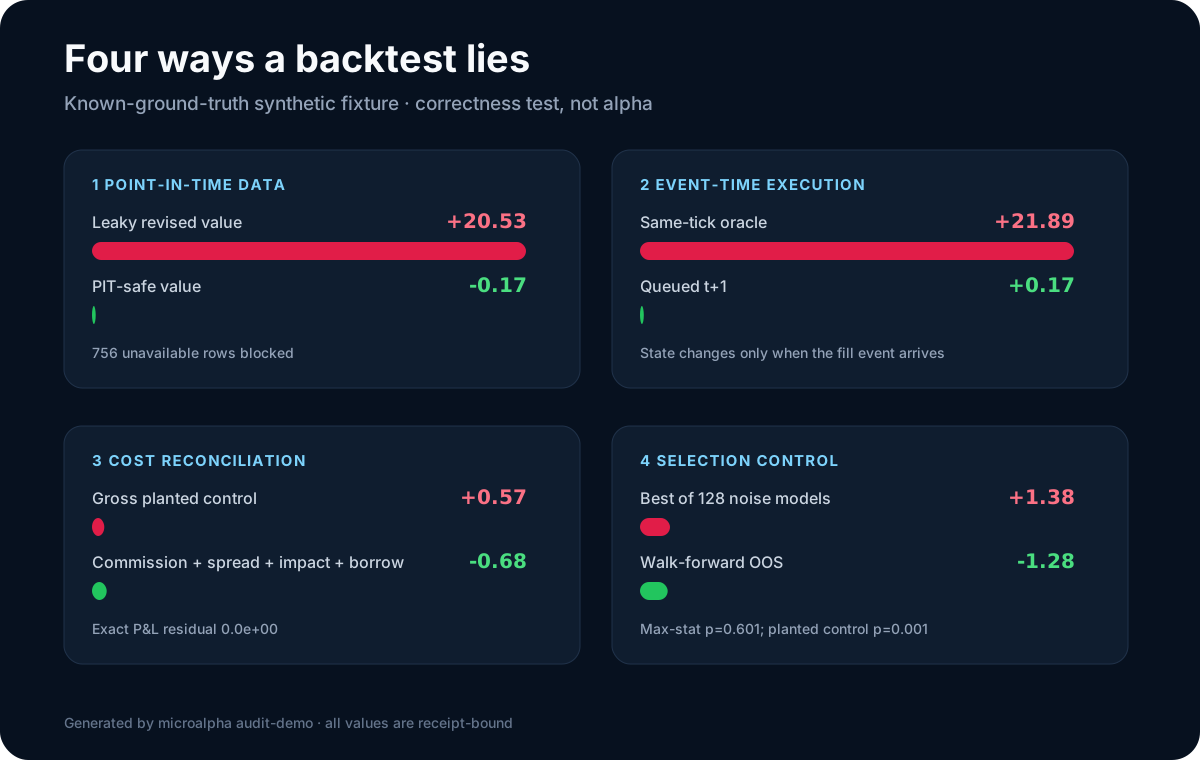
1. Point-in-time availability
The unsafe feature is a revised value that contains the contemporaneous return
but is not available until two sessions later. Using it at the decision time
creates Sharpe +20.5276. The safe path enforces
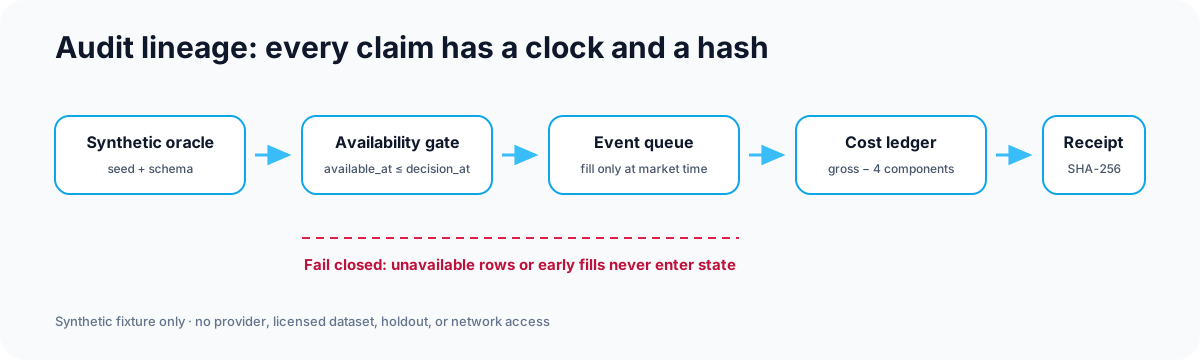
available_at <= decision_at, blocks all 756 unavailable rows, and produces
Sharpe −0.1728 from the information actually available.
The same public require_point_in_time gate raises PointInTimeViolation with
the exact violating row IDs and count instead of silently dropping late data.
2. Event-time execution
The unsafe oracle observes a return and fills on the same tick, producing Sharpe
+21.8860. The safe vector fixture shifts the signal to the next observation;
its Sharpe is +0.1739.
The separate production regression test uses a clock-guarded data handler: any attempt to read a future price before its event raises immediately. It also records cash and positions at each strategy callback, proving the future fill cannot mutate state early.
3. Cost reconciliation
A labeled planted control has gross Sharpe +0.5668. Commission, half-spread,
impact, and borrow costs reduce it to −0.6753. Net returns reconcile exactly:
net = gross - commission - half_spread - impact - borrow
max absolute residual = 0.0
These costs are fixture parameters, not empirical venue calibration.
4. Model-selection control
Searching 128 noise strategies over the full sample finds an apparent winner at
Sharpe +1.3802. A model selected only on the first 504 observations scores
−1.2781 on the untouched final 252 observations.
The max-statistic test evaluates every candidate as a return differential to an
explicit zero-return benchmark. It recenters differentials under the null and
uses the same stationary-bootstrap timestamps for every candidate, preserving
cross-model dependence. The noise family is not promoted (p=0.601); a labeled
planted positive control is detected (p=0.001).
Canonical artifacts
| File | Purpose |
|---|---|
audit_results.json |
Exact metrics and claim boundary |
comparison.csv |
Four-row machine-readable comparison |
audit_lab.svg |
Reviewer-facing result graphic |
data_lineage.svg |
Architecture and data-lineage graphic |
receipt.json |
Input and artifact SHA-256 hashes |
The receipt itself has SHA-256
6e36c2397696d7e9eecbd058cbfc1ba522c8ffba7e5798224de86b20457b6575.
Paths, clocks, hostnames, and Git metadata are excluded from canonical bytes.
Python API
from microalpha.audit_lab import run_audit_lab

result = run_audit_lab("evidence")
assert result["receipt_sha256"] == (
    "6e36c2397696d7e9eecbd058cbfc1ba522c8ffba7e5798224de86b20457b6575"
)
This equality verifies the fixture and generator version used by this release; it is not a universal hash across future schema versions.