Microalpha v0.3 Portfolio Impact Brief
Positioning
Microalpha is a quantitative research evidence engine: it turns a market hypothesis into source-hashed data, point-in-time decisions, target-position orders, next-session fills, explicit costs, walk-forward folds, corrected inference, and a machine-verifiable report.
The one-minute proof has two layers: the Market Risk Case shows real empirical usefulness; Audit Lab proves the research discipline rejects leakage, impossible execution, omitted costs, and selection overfitting.
Public product: GitHub · Pages · latest release
Independent gap audit and disposition
The live v0.2.0 tree and Pages site were evaluated as a senior quant researcher, quant developer, first-time user, reproducibility reviewer, and visual portfolio reviewer. It was compared with the official repositories for NautilusTrader, LEAN, Qlib, and vectorbt. Microalpha should not match their breadth; it should win on auditability and one defensible empirical report.
| Rank | v0.2 gap | v0.3 disposition |
|---|---|---|
| 1 | Synthetic fixture dominated; no public real-data report | Added the fixed 2017–2025 Market Risk Case with a daily ledger, baselines, folds, uncertainty, corrected inference, and polished charts |
| 2 | Dataset lineage was asserted but absent from product evidence | Added publisher/source URL, logical path, SHA-256, schema, rows, dates, availability rule, units, and survivorship boundary |
| 3 | weight meant full order size, not target-position delta |
Added explicit target_weight semantics, repeated resize/flip tests, and drawdown-halt deleveraging behavior |
| 4 | Costs were not decomposed on a real-data path | Added per-row commission, half-spread, nonlinear impact, turnover, participation, stressed costs, and exact reconciliation |
| 5 | Artifact schemas were tests, not a user product | Added microalpha verify for schema, chronology, cost identity, and receipt hashes |
| 6 | Performance proof emphasized a no-op loop | Added report runtime/peak-memory and active execution evidence to the engineering receipt |
| 7 | CI was Linux-only and portable invocation was not prominent | Added Python 3.13, macOS/Windows empirical smoke, and python -m microalpha |
| 8 | Pages was polished but only synthetic above the fold | Put the real-data report first; Audit Lab remains the correctness layer |
The bundled 92 MB data_sp500/ panel is preserved as history but excluded from
v0.3 claims: source, constituent history, calendar, and adjustment semantics
are not pinned strongly enough.
Before / after evaluator
Scores are a compact independent-review rubric, not objective performance metrics. Each after-score is backed by executable evidence.
| Evaluator | v0.2 | v0.3 | Evidence for the change |
|---|---|---|---|
| Senior quant researcher / hiring manager | 3.3/5 | 4.7/5 | Fixed real-data design, risk-matched baseline, folds, uncertainty, all variants disclosed, no-alpha conclusion |
| Quant developer / performance engineer | 3.8/5 | 4.7/5 | Target-position semantics, strict t+1 clock, cost identity, verifier, portable CI, objective benchmarks |
| First-time open-source user | 4.0/5 | 4.7/5 | One offline command builds the report; the next verifies it; the result appears first |
| Scientific reproducibility / lineage | 3.4/5 | 4.8/5 | Source hash, schema, availability rule, daily ledger, and artifact receipt |
| Visual portfolio reviewer | 4.2/5 | 4.8/5 | Real-data hero, equity/drawdown panel, lineage graphic, concise claim boundary |
Evidence that matters
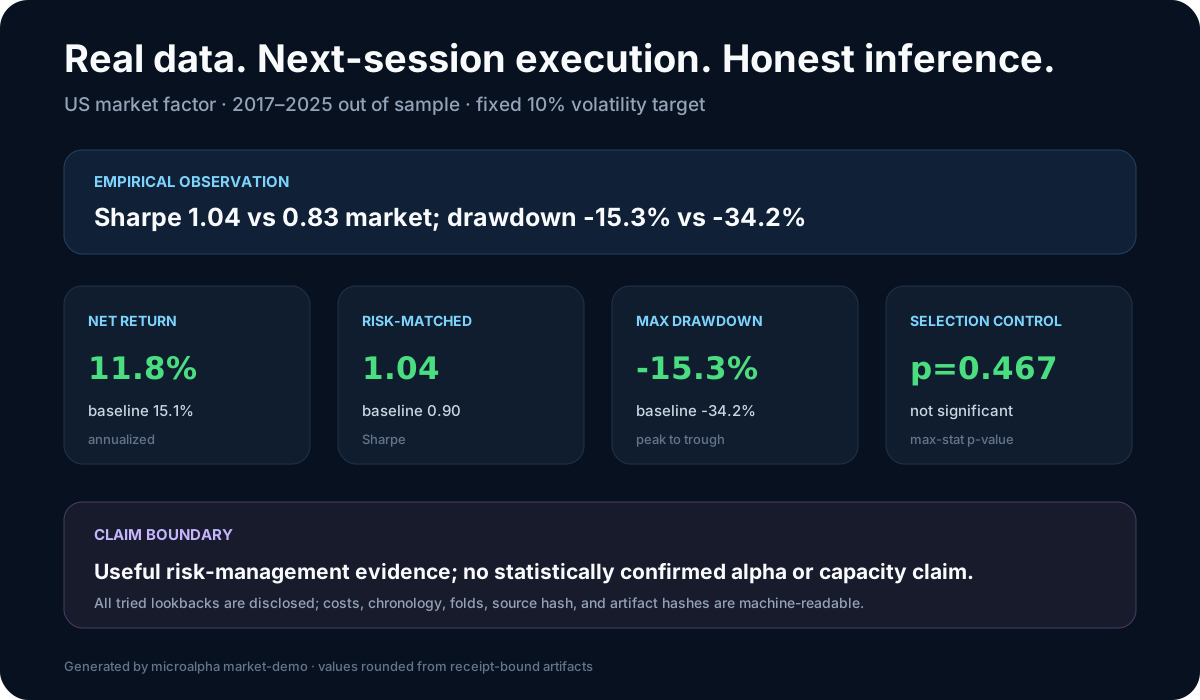
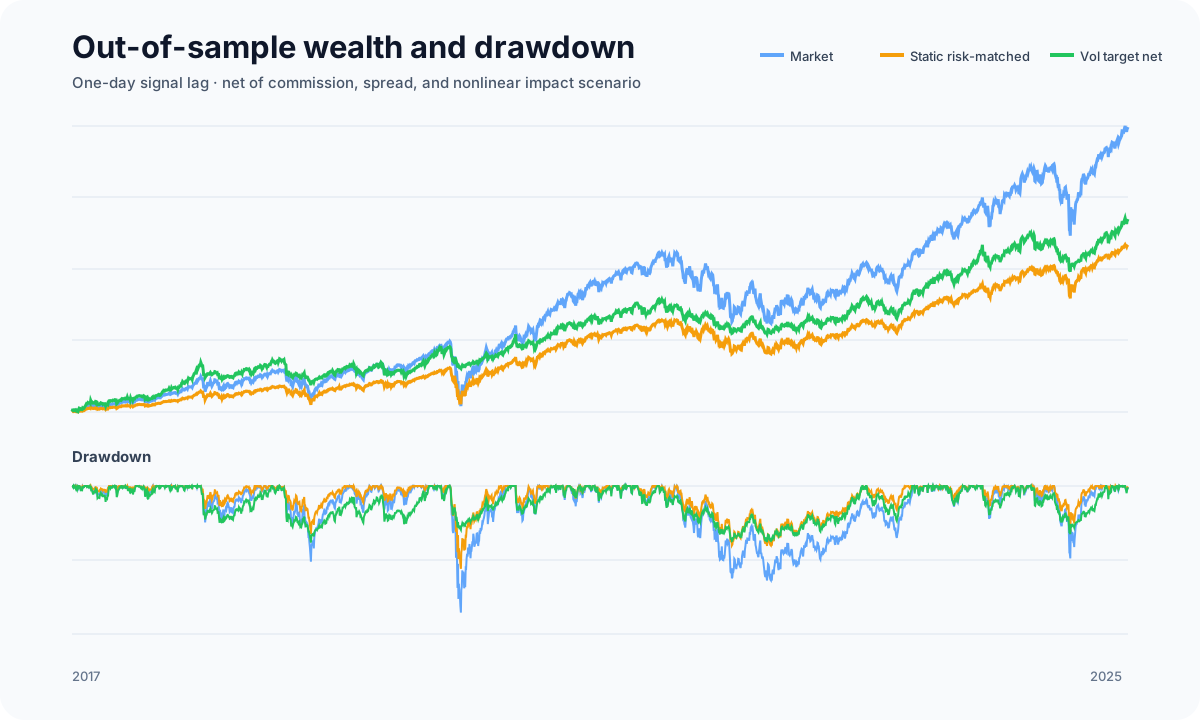
The fixed 21-session, 10%-volatility rule was evaluated from 2017 through September 2025. Net annualized return was 11.77% versus 15.14% for the market; realized volatility was 11.37% versus 19.25%; Sharpe was 1.04 versus 0.83; maximum drawdown was −15.31% versus −34.22%. A static risk-matched market exposure produced Sharpe 0.90 and drawdown −22.38%.
The best disclosed lookback did not beat the risk-matched baseline after
synchronous stationary max-statistic correction (p=0.467). The accurate
conclusion is: risk management improved materially in this sample; alpha was
not established.
Canonical evidence: metrics.json ·
daily.csv ·
folds.csv ·
selection.json ·
data_manifest.json ·
receipt.json
Resume bullets
- Built an event-driven Python quant research engine that enforces point-in-time data availability, next-session execution, target-position rebalancing, and reconciled commission/spread/impact costs across walk-forward studies.
- Shipped a deterministic public-factor risk case over 2,198 OOS sessions:
reduced maximum drawdown from 34.2% to 15.3% and raised descriptive Sharpe
from 0.83 to 1.04, while withholding an alpha claim after multiple-testing
correction (
p=0.467). - Designed machine-verifiable research artifacts with source/output SHA-256 receipts, versioned schemas, annual folds, block-bootstrap uncertainty, cross-platform CI, and clean-clone replay.
90-second interview explanation
“Microalpha is built around the idea that a backtest result is not evidence until its data clock, execution clock, costs, selection process, and provenance are inspectable. In the real-data case, I use a fixed volatility-targeting rule on a public US market factor. Every signal is lagged one session, portfolio orders are deltas to target exposure, and commission, spread, and nonlinear impact reconcile exactly to net returns. I compare against both the market and a risk-matched static exposure, emit yearly folds and bootstrap uncertainty, and correct across every lookback I tried. The rule cut drawdown and improved descriptive Sharpe, but corrected differential return was not significant, so the product says ‘useful risk engineering, no alpha claim.’ A separate Audit Lab proves the pipeline catches four classic ways a backtest can lie. Both reports rebuild offline and verify from hashes.”
Screenshots
The product pages lead with the real-data result and preserve the exact claim boundary in the visual itself:
The live GitHub README and Pages site are the provider-rendered views; both are checked at desktop and narrow viewport after release.
Remaining weaknesses
- The input is a published factor return, not an executable security; costs and participation are transparent sensitivities, not venue calibration or capacity proof.
- The historical
data_sp500/panel remains large and inadequately sourced. It is preserved for history and excluded from v0.3 claims. - Retrospective walk-forward evidence is not prospective live confirmation.
- Microalpha is research software, not a broker, venue, or live trading system.