Microalpha
A quantitative engineering lab that turns market data into source-hashed, chronology-safe, costed evidence—and makes invalid backtests visibly fail.
Real-data result
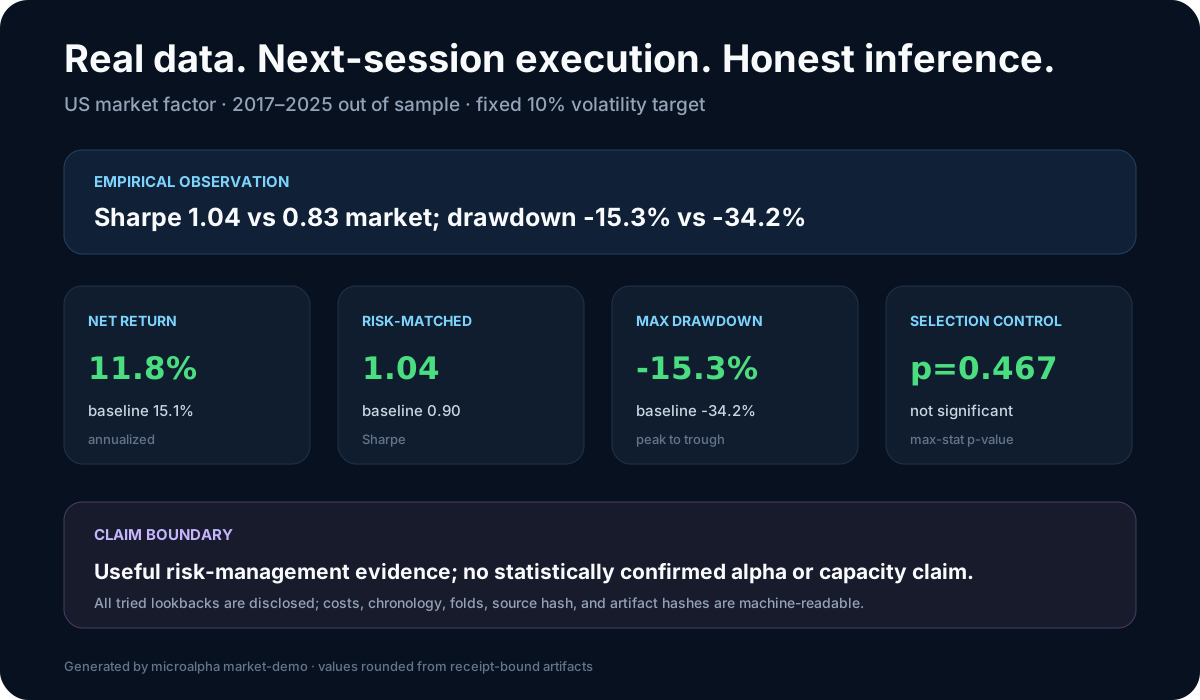
The fixed market volatility-targeting case is evaluated out of sample from 2017 through September 2025 with a one-session signal delay, target-position rebalancing, an explicit commission/spread/impact ledger, annual folds, a risk-matched baseline, block-bootstrap uncertainty, and max-statistic selection control.
It reduced maximum drawdown from 34.2% to 15.3% and raised descriptive Sharpe
from 0.83 to 1.04, but its differential return was not statistically significant
after all four lookbacks were disclosed (p=0.467). Annualized return was
11.8%, below the market's 15.1%. This is useful risk-engineering evidence; the
investment claim is none.
git clone https://github.com/MateoBodon/microalpha.git
cd microalpha
python -m pip install .
python -m microalpha market-demo
python -m microalpha verify docs/assets/market_case
Install from this repository or a signed GitHub release; the namesake package on PyPI is an unrelated third-party project.
Inspect the real-data method, daily ledger, folds, source manifest, and receipt →
Correctness proof
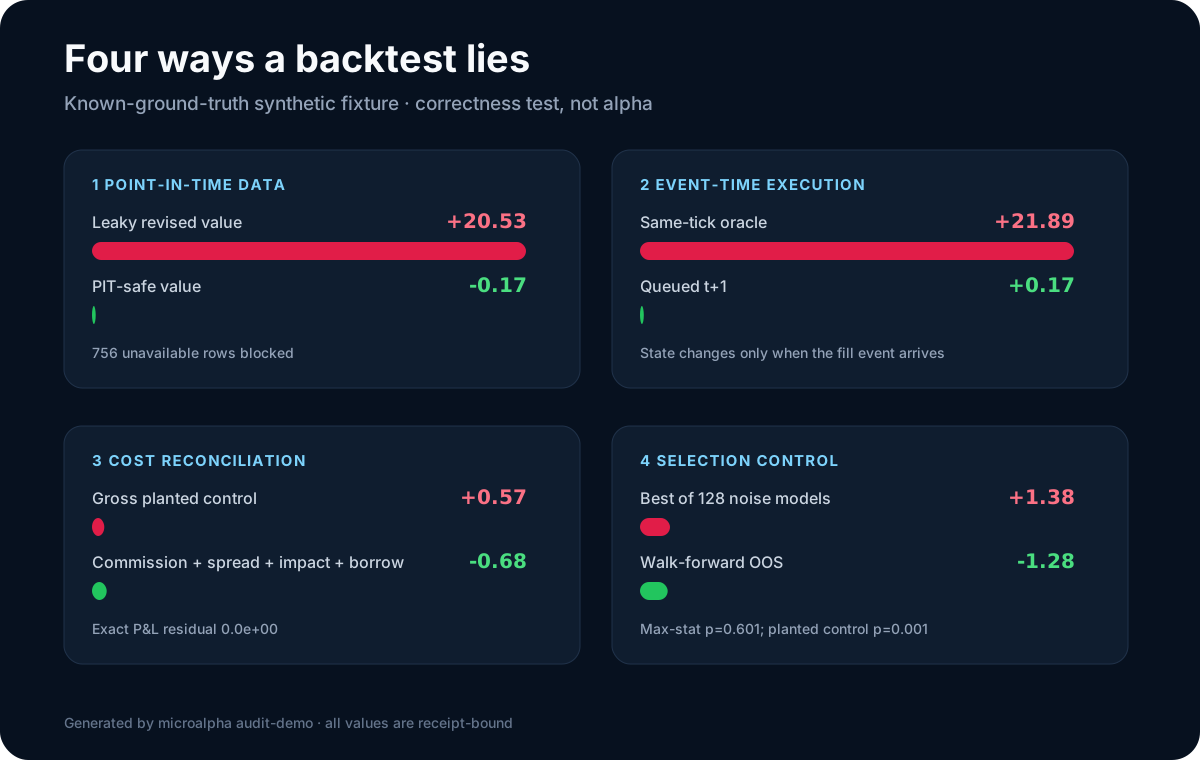
Audit Lab injects data leakage, same-tick execution, omitted costs, and naive model selection into a deterministic known-ground-truth fixture. The safe path blocks or removes each failure, while a labeled positive control still passes.
python -m microalpha audit-demo
python -m microalpha verify docs/assets/audit_lab
All Audit Lab values are synthetic software-test outputs, never market or alpha claims.
Product path
- Market Risk Case — real data, baselines, costs, folds, uncertainty, lineage, and honest inference.
- Audit Lab — known-ground-truth correctness fixtures.
- Architecture — event scheduling and component boundaries.
- API — portable CLI and Python extension points.
- Reproducibility — schemas, receipts, and clean-run gates.
- Limitations — what the system does not prove.
The licensed-data research case documents a separate negative discovery campaign: six mechanisms failed frozen promotion gates while the 2023–2025 confirmation set remained sealed.